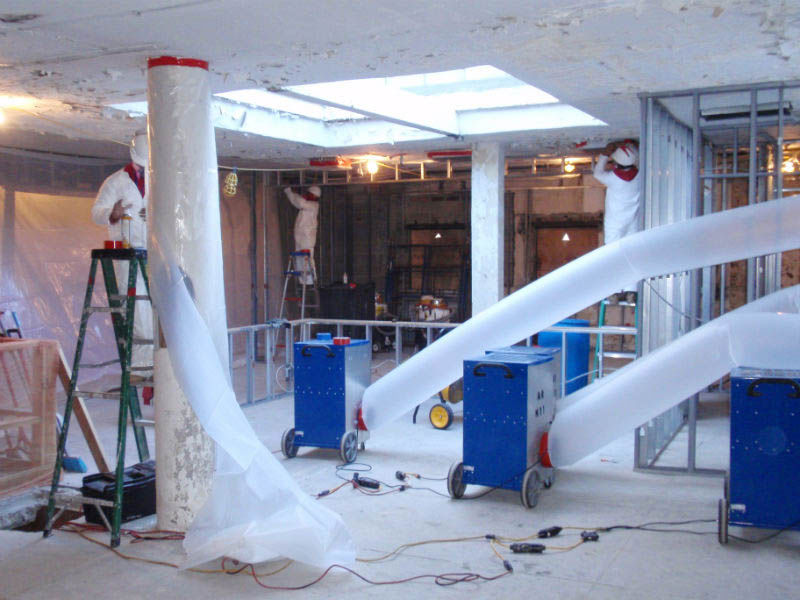
In doing all types of construction work Alliance Commercial Construction comes across mold quite frequently. Since mold can be a great cause for concern we take it very seriously. Once mold is found on site we send our certified mold specialists to make sure your building and the person within it are safe. Understanding the nature of the mold growth is half the battle. To guarantee our mold remediation service we follow our state-of-the-art process to ensure your building is safe and free of mold. ACCL has developed one of the most accurate site assessments in the industry with over 75 years combined experience to back it up.
WARNING: IF YOU SUSPECT MOLD GROWTH IN YOUR BUILDING, DO NOT TOUCH IT. TOUCHING MOLD COULD SEND POTENTIALLY TOXIC SPORES INTO THE AIR WHICH YOU COULD BREATH IN. IF YOUR SUSPECT MOLD CALL NOW BEFORE SOMEONE GETS SICK!
Our Mold Remediation Process
Step 1: Site Assessment
Our specialist will be on site to test air quality, water damage, condensation buildup, length of time the mold has been present and possible symptoms a person on site may be having. This will give us a good insight on exactly how much and of what type of mold we are dealing with. It is important to know what type of mold we are dealing with to know how to treat it.
Step 2: Visual Assessment
Our mold specialist will take a visual assessment and walk through to determine is there may be other trouble spots on-site. Using infrared thermography we can determine is there is possibly mold where you can’t see. Using this technology it is possible for us to catch the problem before mold is a problem. Saving you and your business time, money.
Step 3: Moisture Meter Testing
Using state-of-the-art digital moisture meters our technician will test suspect areas to determine is mold or water damage is present.
Step 4: Mold Air Testing
Using Digital Air Particle Counters indoor and outdoor we can have immediate risk results that will determined and explained to you in your mold report.
Step 5: Hot & Cold Spot Testing
Using laser thermometers we will determine if your building has any possible hot or cold spots. These spots can contribute to overall humidity within the building cause mold the grow.
Step 6: Potential Airflow Problem Testing
A common problem that contributes to mold growth is a clogged central AC unit. Using digital airflow meters we are able to determine if a clog is present and will probide steps on how it will be fixed.
Step 7: Particle Count Testing
Using lighthouse indoor particle counters we will test the property for air quality assurance. If elevated particle counts are present it will be reported. If this is a major cause for concern you will be notified as soon as possible.
Step 8: Humidity Testing
Using a psychrometer we are able to accurately determine the overall humidity throughout your property. It is important to know if the levels are acceptable to assure future mold growth does not happen.
Step 9: Deep Moisture Testing in Problem Areas
Using a hydrosensor moisture problem areas will be testing to determine the next step for those particular areas.
Step 10: Client Requested Water Tests
By request of you we are able to provide on-site water tests including but not limited to: Adenosine Triphosphate (ATP), Total Dissolved Solids (TDS) and PH tests. This will help you determine if the drinking water within the building has any chemicals or pollutants within it. Additional tests available.
Step 11: Report Results
After all of the tests are done and the full assessment is looked over by a mold specialist we will forward the results to you with a comprehensive report on how the mold and other issues can be remediated.
Step 12: Clarity and Explanation
After you have read the report we will give you a call to allow you to ask any questions you may have or anything that needs clarification.